

Blackjack Strategies: Basic Strategy Charts and Betting Systems
Blackjack is different from many casino games because your decisions shape how a hand plays out and can affect whether you win or lose. That control makes blackjack strategies especially useful, though no strategy can remove chance or guarantee a win. If you’re new to the choices available at the table, this guide is a good place to start. We cover basic blackjack strategy—which matches your first two cards with the dealer’s upcard—along with betting systems, card counting, and other approaches you may encounter while playing.
Blackjack Strategies: From Basic Plays to Advanced Techniques
When you play blackjack, you can use several approaches to guide your decisions. These include following a basic strategy chart, using a blackjack betting system, trying card counting, and more.
Here’s a brief look at the main approaches before we explore most of them in more detail:
- Basic Strategy: Basic strategy is the most widely used blackjack approach and worth learning before you play. It sets out what to do in each situation, though memorising the decisions is better than relying on a chart at the table. Its recommendations are based only on your cards and the dealer’s face-up card, also called the upcard.
- Blackjack Betting Systems: Betting systems are another common approach. Since blackjack odds are relatively close to even money, players often use systems in this traditional table game. Martingale, 1-3-2-6, Paroli, and Labouchère are popular examples; each changes the next wager after a win or loss according to its own rules.
- Card Counting: We don’t recommend card counting because land-based casinos generally disapprove of it, even though it is not illegal in most of them. Professional blackjack players have nevertheless used the technique for years. It tracks dealt cards to estimate whether the remaining shoe may contain more favourable cards.
Basic Blackjack Strategy
Basic blackjack strategy is a clear way to make informed decisions in this popular casino game, which is why it is central to this guide. We’ll explain which moves to make in specific situations and provide several strategy charts to help you follow those decisions.
The charts show when to hit or stand based on your cards and the dealer’s face-up card. Basic strategy also covers when to surrender, split, or double down.
- Surrender Strategy: This strategy explains when to use the surrender rule. You may surrender when your chances of winning appear very low, giving up the hand and keeping half your wager rather than risking the entire amount.
- Splitting Strategy: Splitting strategy uses mathematical guidance to show when splitting is advisable and when it isn’t. The move is intended to reduce the house edge, but players often split incorrectly. For instance, splitting a pair of 10s straight away is a common mistake this strategy advises against.
- Doubling-Down Strategy: Doubling down is an aggressive option generally considered when the dealer appears to be in a vulnerable position.
Basic Blackjack Doubling-Down Strategy
After the initial blackjack deal, you can choose from several actions. You may take or decline the available options, while the dealer must follow predetermined rules.
Doubling down is one of the strongest options available. It means increasing your original wager for the hand by at least 100%, then taking just one more card before the hand is completed.
You can double down only as your first move after receiving your initial two cards. Suppose you’re playing single- or multi-deck blackjack and receive a 6 and a 5, for a total of 11, against the dealer’s 4 upcard. Doubling is mathematically favourable here: you have over 30% chance to draw a ten-valued card and reach 21.
Following the right doubling-down rules is important when using blackjack strategy. This summary is a handy reference. Memorising and applying it can help you make more consistent decisions, but it cannot guarantee a winning session.
- Single-deck total of 11 – double down against every card the dealer shows.
- Multi-deck total of 11 – double down against any dealer card except an ace.
- Total of 10 – double down against dealer cards 2 to 9 in both single- and multi-deck games.
- Total of 9 – double down against dealer cards 3 to 6 in multi-deck games and 2 to 6 in single-deck games.
- Total of 8 – never double down in multi-deck games. In a single-deck game, double only against a dealer 5 or 6.
First check whether the casino and blackjack variant allow doubling on soft hands. If permitted, treat soft 11 like hard 11 and double down. If doubling isn’t allowed, hit instead.
The Blackjack Surrender Rule
Some blackjack variants let you surrender immediately after the initial deal if your hand seems unlikely to win. Surrendering returns half your original bet rather than risking the entire wager on a likely loss.
There are two types of surrender in blackjack: Early Surrender and Late Surrender. They take place at different points in the deal, so understand the difference before choosing a game with surrender.
Blackjack Early Surrender
Early surrender lets you give up your hand as soon as you receive your cards, before the dealer checks for a natural blackjack. If you surrender, half your original wager is forfeited.
This is the more favourable form of surrender because you can use it regardless of the dealer’s hand. However, it is gradually disappearing from casino games.
Early surrender reduces the casino’s house edge. Casinos that still offer it often offset this advantage with another rule intended to recover some of the edge returned to the player.
When to use Early Surrender
- When the dealer shows an Ace and you hold a hard 5, 6, 7, 12, 13, 14, 15, 16 or 17
- When the dealer shows an Ace and you hold a pair of 3’s, 6’s, 7’s or 8’s
- When the dealer shows a 10-valued card and you hold a hard 14, 15, 16 or a pair of 7’s or 8’s
- In a 2-deck game, when the dealer shows a soft 17 and you hold a pair of 2’s.
When not to use Early Surrender
- Never surrender a 10-valued card against the dealer’s 4 and 10 or 5 and 9 in single-deck blackjack.
- In 2-deck blackjack, never surrender a 10-valued card against the dealer’s 4 and 10.
Blackjack Late Surrender
Late surrender lets you give up your hand and forfeit half your original bet, but only after the dealer checks and confirms they don’t have a natural blackjack. If the dealer does have one, surrender isn’t available and you lose your original bet.
Late surrender reduces the house edge less than early surrender, but it still offers a mathematical advantage over playing a game with no surrender option.
Late surrender is available in some blackjack games at casinos worldwide and in most online casinos. At a land-based table, you may need to ask the dealer whether it’s offered; casinos don’t generally highlight the option.
When to use Late Surrender
- When the dealer shows an Ace or 10-valued card and your hand total is 15
- When the dealer shows an Ace or 10-valued card and your hand total is 16, including pair 8’s
- When the dealer shows an Ace and your hand total is 17
When not to use Late Surrender
- For single-deck blackjack where the dealer stands on soft 17, stand if the dealer shows a 9, 10 or Ace and your hand totals 15.
- In single-deck blackjack, when the dealer shows a 9 and you have a hand total of 16
- For single-deck blackjack where the dealer stands on soft 17, stand if the dealer shows 9 or 10 and your hand totals 17.
How to Use a Basic Blackjack Strategy Chart
| 2 | 3 | 4 | 5 | 6 | 7 | 8 | 9 | 10 | A | |
| 5 | H | H | H | H | H | H | H | H | H | H |
| 6 | H | H | H | H | H | H | H | H | H | H |
| 7 | H | H | H | H | H | H | H | H | H | H |
| 8 | H | H | H | D | D | H | H | H | H | H |
| 9 | D | D | D | D | D | H | H | H | H | H |
| 10 | D | D | D | D | D | D | D | D | H | H |
| 11 | D | D | D | D | D | D | D | D | D | D |
| 12 | H | H | S | S | S | H | H | H | H | H |
| 13 | S | S | S | S | S | H | H | H | H | H |
| 14 | S | S | S | S | S | H | H | H | H | H |
| 15 | S | S | S | S | S | H | H | H | H | H |
| 16 | S | S | S | S | S | H | H | H | H | H |
| 17 | S | S | S | S | S | S | S | S | S | S |
| A,2 | H | H | D | D | D | H | H | H | H | H |
| A,3 | H | H | D | D | D | H | H | H | H | H |
| A,4 | H | H | D | D | D | H | H | H | H | H |
| A,5 | H | H | D | D | D | H | H | H | H | H |
| A,6 | D | D | D | D | D | H | H | H | H | H |
| A,7 | S | DS | DS | DS | DS | S | S | H | H | S |
| A,8 | S | S | S | S | DS | S | S | S | S | S |
| A,9 | S | S | S | S | S | S | S | S | S | S |
| 2,2 | P | P | P | P | P | P | H | H | H | H |
| 3,3 | P | P | P | P | P | P | P | H | H | H |
| 4,4 | H | H | P | P | P | H | H | H | H | H |
| 5,5 | D | D | D | D | D | D | D | D | H | H |
| 6,6 | P | P | P | P | P | P | H | H | H | H |
| 7,7 | P | P | P | P | P | P | P | H | S | H |
| 8,8 | P | P | P | P | P | P | P | P | P | P |
| 9,9 | P | P | P | P | P | S | P | P | S | S |
| T,T | S | S | S | S | S | S | S | S | S | S |
| A,A | P | P | P | P | P | P | P | P | P | P |
Blackjack rules
Following basic strategy is one of the most practical ways to make better blackjack decisions. It means choosing the action with the strongest statistical likelihood in each situation, so recommendations are based on mathematics rather than instinct.
There are several types of basic blackjack chart. You can find many online, and we’ve included a selection later in this guide. Each shows the mathematically preferred action, but it’s important to choose the chart that fits your game.
The chart you need depends on the rules at your table. A house edge advertised at 0.5% theoretically means you ‘can’ win 99.5% of the time over the long run, but this assumes you play ‘basic strategy’ perfectly. Ignoring the chart could hand the casino 2% of the house edge and lower your theoretical RTP.
Consider these three things when choosing a basic strategy chart:
- How many decks are in the shoe? Blackjack shoes can contain anywhere from 1 to 8 decks, and the number affects when you should ‘hit’, ‘split’, ‘stand’, ‘surrender’ or ‘double’. There are separate charts for 1-deck, 2-deck, 3-deck and 4-deck tables, plus another set for tables with 4 to 8 decks. In general, fewer decks make the house edge/RTP more favourable to the player.
- H17 or S17 charts: Use the H17 basic strategy chart when the dealer must hit on every 17, including a ‘Soft 17’. At an S17 table, the dealer must stand on every ‘Soft 17’ and on hard 17 totals. The S17 chart gives the player a better house edge.
- NDAS or DAS charts: NDAS, or No Double After Split, means you can’t double after splitting. DAS, or Double After Split, allows you to double after splitting. The DAS chart offers the better house edge.
Once you know the table rules, select the chart that matches them. These examples show what the labels mean:
- 1 Deck H17 NDAS: Use this chart for a one-deck shoe where the dealer must hit on all 17s and doubling after a split isn’t allowed.
- 4-8 Deck S17 DAS: This is a multi-deck table where the dealer must stand on a ‘Soft 17’ and on a ‘Hard 17’.
Most Commonly Used Blackjack Basic Strategy Charts
Having a basic strategy chart beside you makes it much easier to play correctly. Match your hand with the dealer’s card, then follow the recommended action for the lowest-house-edge approach available under those rules. It’s an odds-based recommendation, not a promise that you’ll win.
You don’t have to memorise every chart, but doing so makes play more convenient. The more often you refer to the charts, the more familiar the decisions will become.
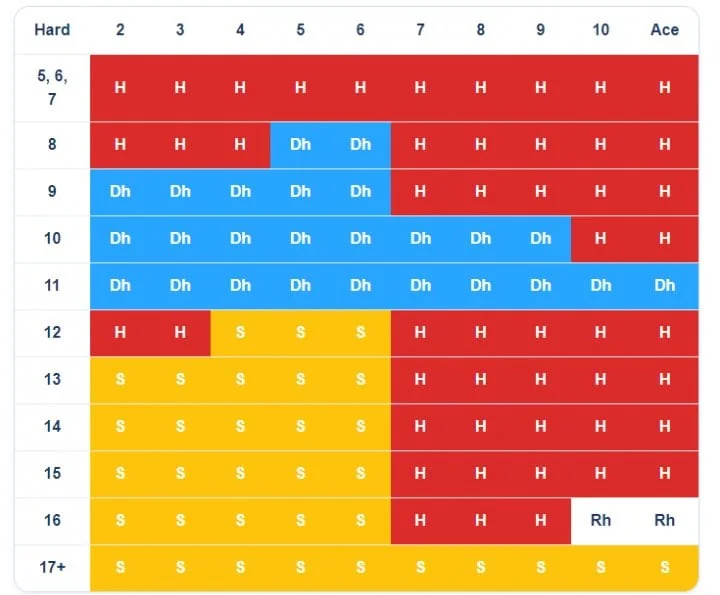
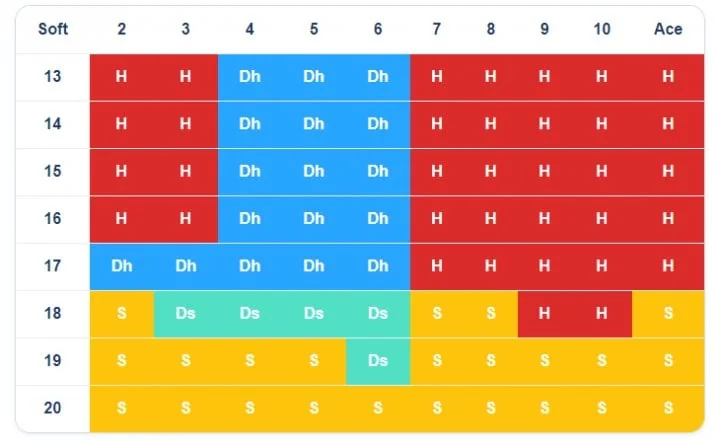
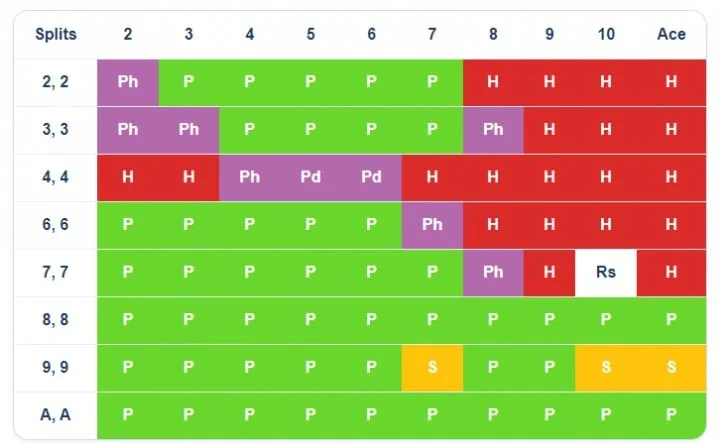
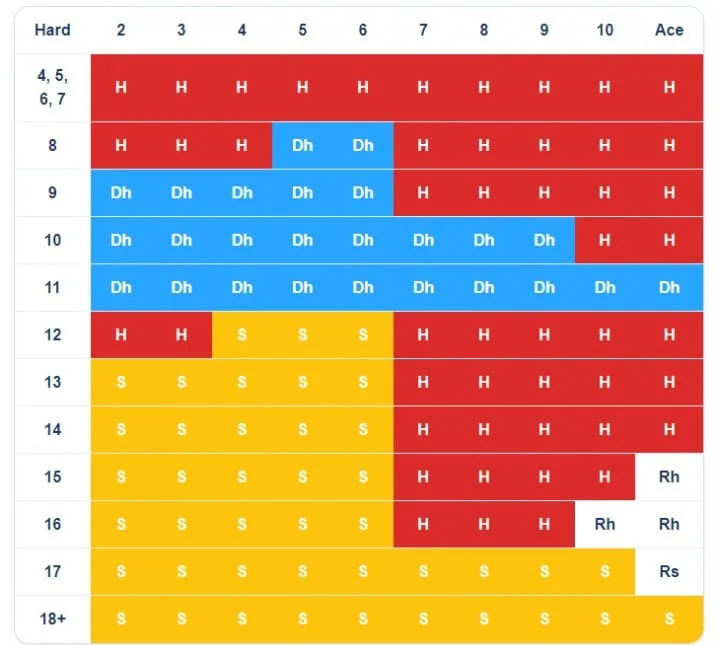
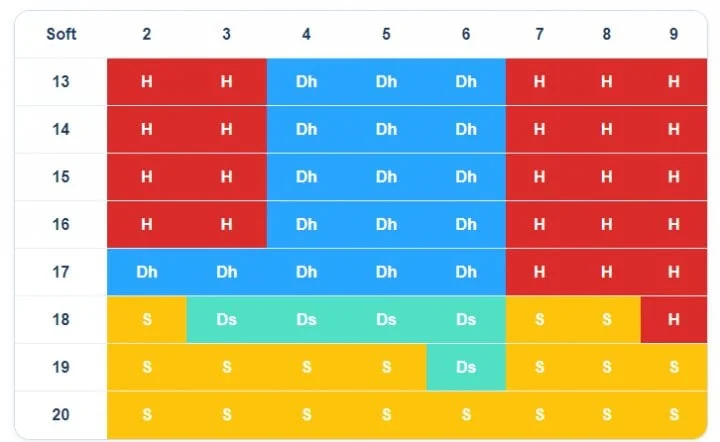
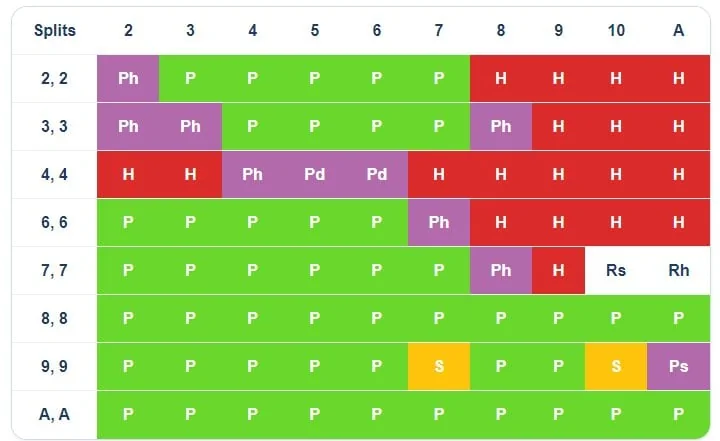
Before we get to the most common charts, it’s useful to learn how to read them. The abbreviations below are standard terms used in the tables; each tells you what to do in a particular situation.
- H = Hit.
- S = Stand.
- P = Split, meaning divide a pair into two separate hands.
- DH = Double Down or Hit. Double when allowed; otherwise, Hit.
- DS = Double Down or Stand. Double when allowed; otherwise, Stand.
- RH = Surrender or Hit. Surrender when allowed; otherwise, Hit.
- RS = Surrender or Stand. Surrender when allowed; otherwise, Stand.
- RP = Surrender or Split. Surrender when allowed; otherwise, Split.
- PH = Split or Hit. Split after Double Down when allowed; otherwise, Hit.
- PD = Split or Double. Split after Double Down when allowed; otherwise, Double.
- PS = Split or Stand. Split after Double Down when allowed; otherwise, Stand.
Single-Deck Blackjack Charts
Using the abbreviations above, the charts below show basic strategy for single-deck blackjack. They cover games where the dealer stands on soft 17, hits on hard 17, and the situations where splitting is the right move.
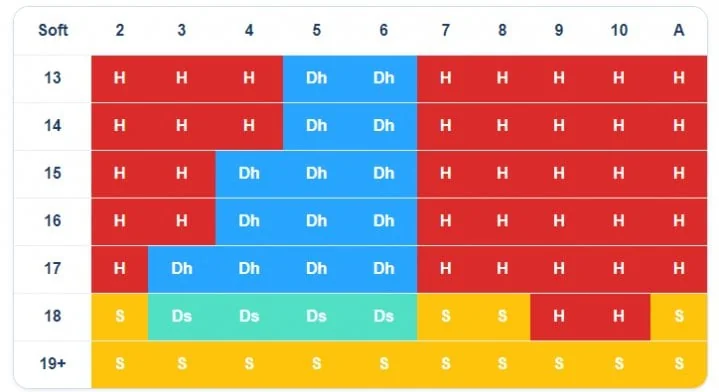
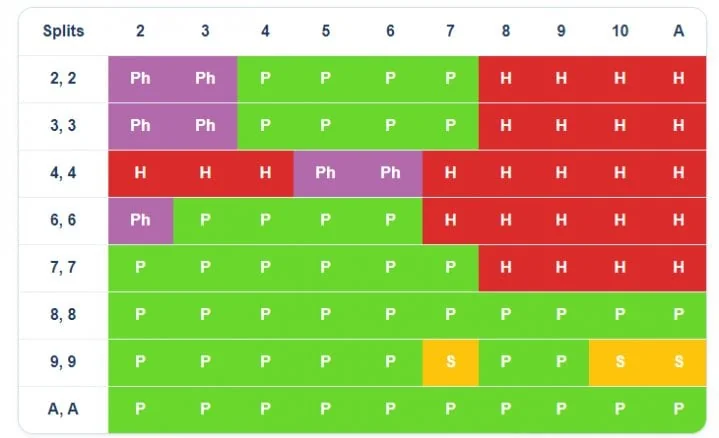
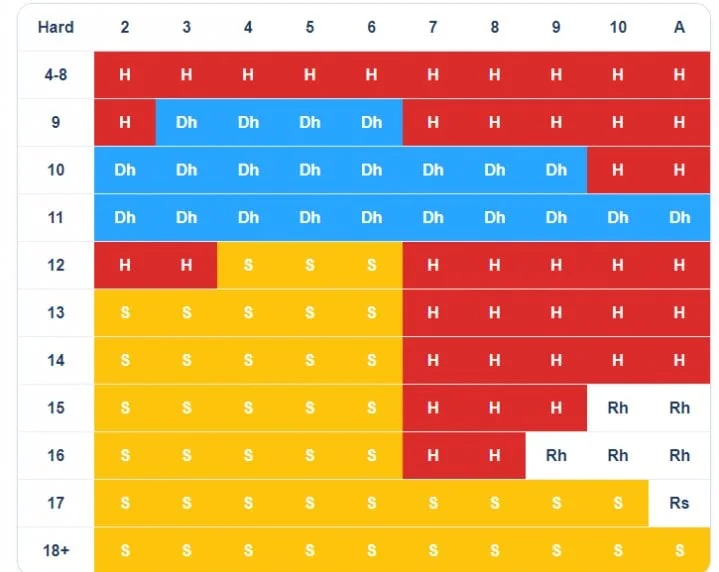
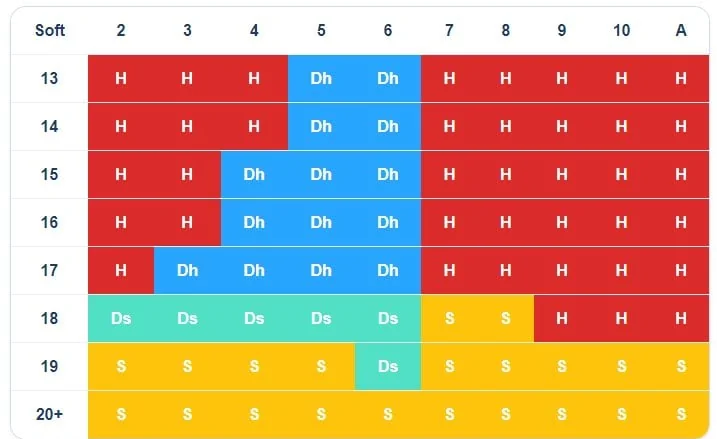
In these charts, your card values run vertically and the dealer’s hand runs horizontally. Find where they intersect to see the action recommended by the relevant blackjack strategy.
Dealer Stands on Soft 17
Dealer Hits on Hard 17
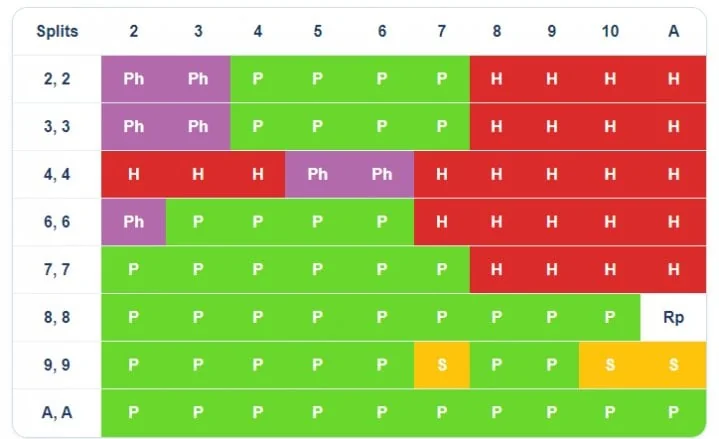
Multi-Deck Blackjack Strategy Charts (4 to 8-deck Games)
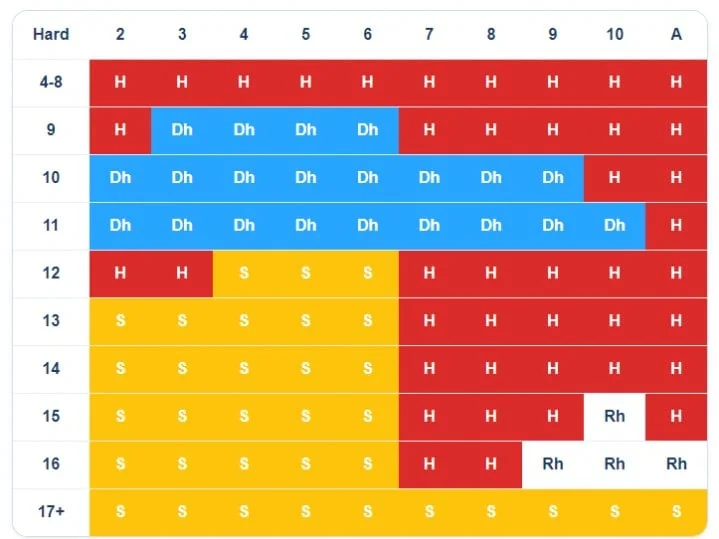
Blackjack has many variations. Although the rules differ, the statistical probabilities are broadly similar. Fewer decks can mean a lower house edge, but the difference is hard to notice; with four or more decks, it matters even less. The following charts can be used for tables with 4 to 8 decks.
For a multi-deck blackjack game, use the following strategy charts:
Dealer Stands on Soft 17
Dealer Hits on Hard 17
Betting Systems in Blackjack
Since the first casinos opened, gamblers have looked for ways to beat the casino advantage. Over the centuries, many have tried to devise systems that deliver repeated winning sessions and substantial returns, but no system can guarantee that result.
The promise of quick, easy money explains why gamblers and mathematicians have pursued blackjack betting systems. Blackjack draws this interest because skill affects decisions: the right strategy can reduce the house edge and improve a player’s odds, but it can’t eliminate the underlying risk.
To be clear, no blackjack betting system has been proven to produce a winning session every time. Websites may promote supposedly foolproof systems, sell them and promise enormous wins. These claims can take advantage of people who are new to casino games, especially blackjack.
Betting Systems vs. Betting Strategies
Betting systems and blackjack playing strategies are often mixed up, but they do different things. A betting system manages the money you wager and usually sets the amount to bet on each hand. For instance, a positive progression system might tell you to double your bet after each win and halve it after each loss.
Playing strategies are about deciding what to do in a particular situation, such as whether to Stand or Hit with A6. Basic playing strategy is supported by mathematical analysis and can lower the house edge, but it doesn’t guarantee you’ll win more than the casino.
The Martingale Betting System
The Martingale betting system is probably the best-known betting system. It’s a negative progression method: double your wager after each loss, then return to your starting bet after a win. The theory is that a win after doubling your wagers recovers previous losses and earns a profit of one betting unit.
It sounds appealing, but every betting system has drawbacks. With Martingale, a long losing streak makes the next wager very large, putting more of your bankroll at risk without guaranteeing you’ll recover your losses.
For example, if your regular wager is $10 and you lose six times in a row, the required bets after the first wager are $20, $40, $80, $160 and $320. The six bets add up to $630. A ten-game losing streak would need even more money, and a long enough run could exceed the table’s maximum bet.
Other Blackjack Betting Systems
Blackjack betting systems usually focus on managing your bankroll and changing wagers according to a set pattern. They’re generally divided into three categories: hedging systems, positive progression systems and negative progression systems.
Other well-known examples include Parlay, Paroli, Labouchère, base two progressive, base five progressive and the 1-3-2-6 betting system. Many other names simply repackage the same ideas for marketing purposes.
Here’s a closer look at some popular blackjack betting systems:
- Paroli System: The Paroli betting system can be thought of as the reverse of Martingale. Instead of doubling after a loss, you double after a win and go back to your starting wager after a loss. This positive progression aims to make the most of winning streaks while limiting the impact of losing ones.
- Labouchere System: With the Labouchere betting strategy, you make a sequence of numbers and wager the sum of the first and last. After a win, remove those two numbers; after a loss, add the amount you wagered to the end of the sequence. The goal is to clear the sequence and finish in profit, but this method needs careful bankroll management and can get complicated.
- 1-3-2-6 Betting System: Each number in the 1-3-2-6 sequence multiplies your starting bet. Follow the sequence after each win, return to your initial wager once you reach the end, and start over whenever you lose.
- Card counting is the only blackjack betting system said to have demonstrated long-term effectiveness, but casinos generally disapprove of it, and some consider it cheating.
Card Counting as a Blackjack Strategy
Blackjack card counting uses mathematics to track the cards dealt from the deck or decks in play. The aim is to estimate which cards remain in the shoe and how likely they are to appear next.
Card counting in blackjack is described as the only sure way to eliminate the casino’s small edge and turn it in the player’s favour by identifying a ‘positive deck” with a high proportion of high-value cards. The counter then bets more when the deck is positive, and less when it’s negative or neutral.
Other General Blackjack Strategies and Tips

Whether you use basic strategy, a betting system or both, these general pointers still apply. They’re straightforward, but following them consistently can help you avoid unnecessary decisions and manage your play:
- Never Make the Insurance Bet: Even if an ace makes dealer blackjack seem likely, the Insurance side bet has negative expected value. You can bet half your stake as insurance; if the dealer has blackjack, the side bet pays 2:1. If not, you win the main bet but lose the insurance wager, so it’s generally better to skip it.
- Never Take Even Money for a Blackjack: Some blackjack tables offer a 1:1 payout when you have blackjack and the dealer shows an Ace, instead of the 3:2 payout available if the dealer doesn’t also have blackjack. If both hands are blackjack, the result is a Push, so taking even money can unnecessarily lower your return.
- Never Play Side Bets: Another common tip is to avoid side bets. Blackjack’s appeal lies in its relatively low house advantage, while side bets generally have a much higher house edge.
- Always Split Aces: Our ‘Splitting’ charts recommend splitting aces when they’re your first two cards. Since decks contain many ten-value cards, splitting gives you two chances to make blackjack. An ace can also count as 1 or 11, although many Las Vegas casinos limit each split ace to one card.
- Stick to a Strategy: Whatever blackjack strategy you choose, follow it consistently for a reasonable period. Switching methods every five minutes can cause confusion and mistakes and may hurt your bankroll. Give a strategy enough time to learn its rules and limitations.
- Minimise Alcohol Consumption: At a blackjack table, calm and controlled decisions are best. Drinking can lower your inhibitions and encourage riskier play, making it easier to abandon basic strategy—which is based on your first two cards and the dealer’s upcard—and lose more than you intended.
- Stay Calm and Don’t Give in to Pressure: At a land-based casino, other players or spectators may try to influence your decision. Ignore the pressure and keep following basic blackjack strategy.
- Use Bankroll Management: Whether you play blackjack or another casino game, set a bankroll plan before you start. Decide how many bets your funds can cover, stick to your starting wager whether you’re winning or losing, and don’t chase losses by raising it. If you lose, stop and come back another day.
Blackjack Strategies: Conclusion
Blackjack gives players more control over their decisions than many casino games, because skill can influence how a hand is played. Chance still determines long-term results, but basic strategy can improve the mathematical odds available under the table rules.
Use the blackjack strategy charts as a foundation for making informed decisions. You could also combine them with a betting system such as Martingale, but remember that a wagering pattern can’t undo losses or guarantee success. Understanding the limits of each blackjack strategy matters more than expecting a certain result.
Play Blackjack with Basic Strategy Today!

Now that you’ve explored basic strategy, blackjack charts, betting systems and other approaches, you may want to try them at a table. Many top online casinos offer blackjack in RNG software and live casino formats. Check the rules of the specific game and use the matching chart before playing.
Don’t choose an online casino based only on its range of blackjack games. Also look at its bonus offers, stated reputation, licensing information and payment options. Casino Ideal publishes online casino reviews to help you compare these details. Review information isn’t independently recertified here and shouldn’t be treated as proof of Canadian availability or authorization.