

How Prediction Market Pricing Works
The first time you open a prediction market and see its figures shifting in real time, it may be hard to make sense of what is happening. Once you understand the basics, the picture becomes clearer. Prices reflect traders backing their views with money, turning many different opinions into figures that serve as an approximate guide to probability.
What Prediction Market Prices Represent
A prediction market contract price is a little like a live poll, except participants put real money behind their views. That financial commitment can make its signal more meaningful than an informal survey. The basic principle works as follows.
How market prices indicate the perceived likelihood of an outcome
The displayed price reflects the views of traders active on the platform. When many expect an event to happen, they buy shares tied to it. The cheapest available shares are purchased first, so later buyers may have to pay more for the remaining supply. This is how the price rises.
Contracts trade between $0.00 and $1.00, so their prices can readily be read as percentages.
Imagine a market asking whether the Republican Party will win the next U.S. presidential election.
- If the "Yes" contract is priced at $0.65, the market implies roughly a 65% chance of a Republican victory.
- The "No" contract would cost $0.35, suggesting a 35% probability for the alternative outcome.
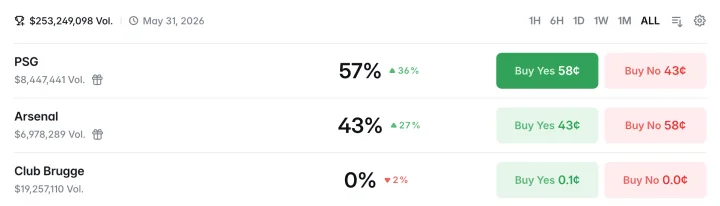
Prices can shift quickly. If favourable news arrives for the Republican candidate and buyers rush in, the "Yes" price might climb to $0.75, taking its implied probability to 75%.
Why prediction market prices are simpler to read than traditional odds
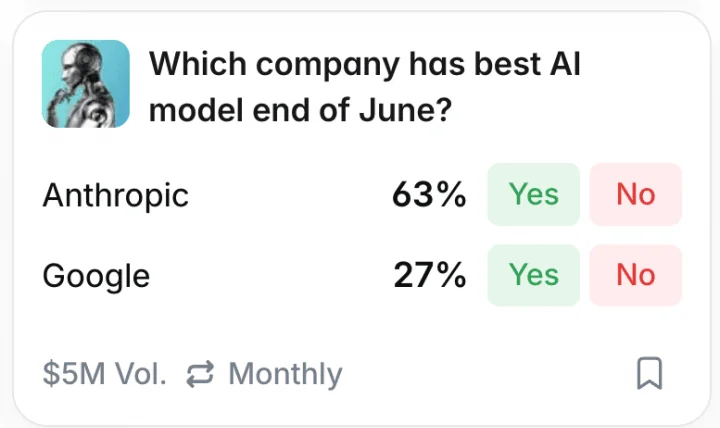
People used to fractional sportsbook odds such as 5/2 or American odds such as +250 know that interpreting them takes extra mental effort. Prediction markets make the idea more direct: a price of $0.40 represents a 40% implied chance, with no conversion needed.
How Prediction Market Contracts Are Priced
The basic setup is straightforward. When a market closes, the winning contract pays exactly $1.00 and the losing contract settles at $0.00. Before the market closes, traders’ actions move the price between those two values.
Why contracts usually trade between $0 and $1
These markets generally have two possible outcomes. The correct contract settles at $1.00, or 100% certainty after settlement, while the incorrect one expires at $0.00, or 0% certainty. Because prices range from $0 to $1, an interim price also offers an accessible estimate of probability.
How payouts connect contract prices to potential profit
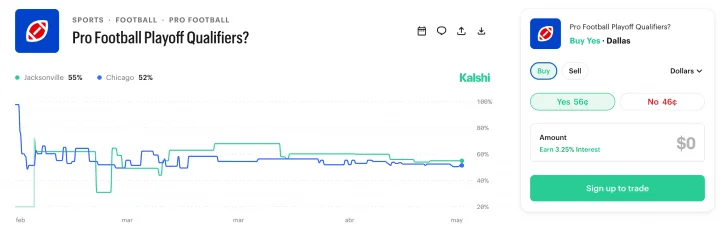
Your potential return is the difference between the price you paid and the $1.00 settlement value. If your prediction is correct, you receive that spread; if it is wrong, the contract settles at zero. Your maximum loss is the amount you paid for it.
For instance, consider an NBA market on whether the Los Angeles Lakers will make the playoffs.
- You buy "Yes" contracts for $0.40 each, which implies a 40% chance at that time.
- If the Lakers qualify, each contract settles at $1.00, giving you a net profit of $0.60 per share. A purchase of 100 contracts for $40 would return $100, for a gain of $60.
- If they do not qualify, the contracts are worth nothing and you lose the $40 you paid.
How "Yes" and "No" contracts represent opposing probabilities
Together, the "Yes" and "No" contracts total $1.00, or 100%. If "Yes" costs $0.75, the corresponding "No" price is $0.25. Their prices show how the market weighs the two possible outcomes.
How the Market Sets Prices
Prediction market prices are not set by a central authority. They develop as traders place buy and sell orders, and those interactions determine the prices shown on the platform.
How supply and demand between buyers and sellers set prices
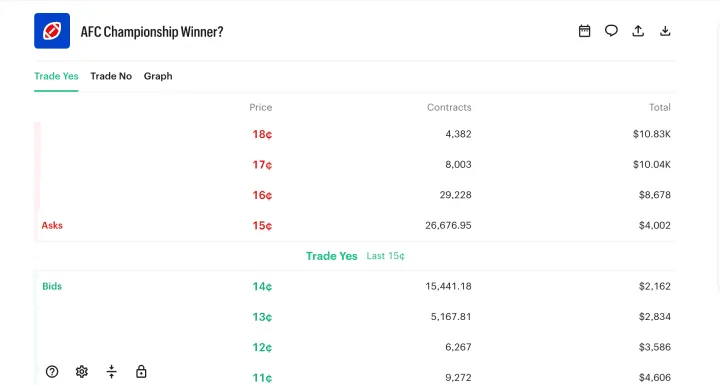
It comes down to supply and demand. When buyers seek "Yes" shares, the cheapest offers are filled first; the next available shares cost more, pushing the price higher. When sellers outnumber buyers, they may reduce their offers to find someone willing to take the other side, putting downward pressure on the price.
How bids, asks and matched orders shape the current price
Trades are handled through an order book. A "bid" is the highest price a buyer is willing to pay, while an "ask" is the lowest price a seller will accept. When those prices meet, a trade takes place, setting the latest market price.
Here is the process, step by step.
- A Bid Is Placed: A buyer submits an order for 100 shares at $0.40 each. The order enters the book and sets a current bid of $0.40.
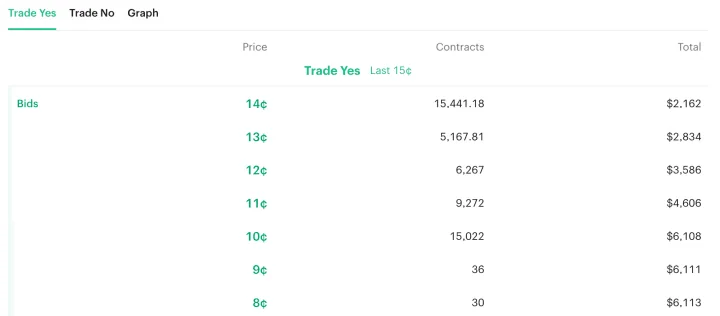
- An Ask Is Placed: A seller offers 50 shares at $0.44. No buyer has accepted that price yet, so the order stays open and the market price remains at the previous trade.
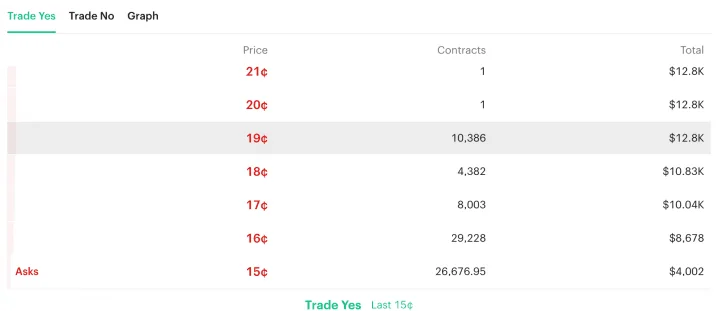
- An Order Is Matched. A new buyer accepts the $0.44 ask and purchases all 50 shares. The completed trade takes the market price to $0.44.
Why each trade can update the market’s implied probability
Every completed transaction represents a new agreement between a buyer and seller on what a contract is worth. Because money is at stake, each trade contributes to the market’s changing consensus and can immediately alter its implied probability.
What Makes Prediction Market Prices Move
Market movements reflect real-world developments and trader behaviour; they do not happen at random. A headline can change expectations in seconds, and a large trader opening a position can move a price just as quickly.
How breaking news and new information change contract prices in real time
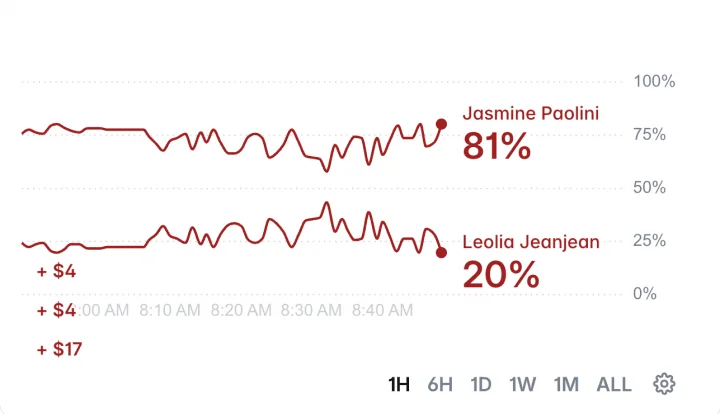
When significant news breaks, traders often react by buying or selling right away. The quick response can cause sharp, sudden changes in a contract’s price.
A notable historical example came during the first presidential debate between Joe Biden and Donald Trump in late June of 2024. As the debate unfolded, the contract on a Biden victory fell from $0.34 to $0.22. At the same time, the price in the market asking whether he would leave the race rose from $0.22 to $0.43.
How liquidity influences the pace and scale of price movements
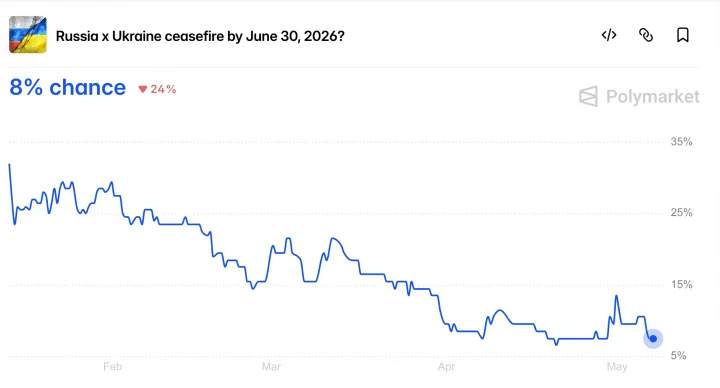
Liquidity—the level of trading activity and the amount of money moving through a market—has a major impact on price stability.
A market with high liquidity can absorb large orders without dramatic price swings because traders are available on both sides. In a low-liquidity market, even a moderately sized trade can push the price sharply in one direction.
That helps explain why platforms such as Polymarket and Kalshi often feature in discussions about prediction markets. Their user and capital bases can sustain considerable trading, limiting the influence of any one trade on prices.
Why low-volume markets can see sharper, less dependable swings
In a market with few trades, one reasonably large order can take up all the shares available at a given price and cause a sudden jump. There may not be enough capital to absorb it gradually. The displayed price may therefore be a poor measure of broad trader consensus.
How Traders Read Prediction Market Prices
Reading a market means looking beyond a single number. Experienced traders compare the implied probability with their own research and judgement, then look for a possible gap between the market price and their assessment.
How to interpret a contract price as a probability estimate
It takes little effort to translate a contract price into an implied probability. A contract at $0.60 means the market assigns the outcome a 60% chance.
Take a market asking whether the U.S. unemployment rate will exceed 4.0% this month.
- If the "Yes" contract trades at $0.30, traders collectively imply a 30% chance that the rate will cross the threshold.
- The "No" contract would cost $0.70, implying a 70% chance that it will not.
Suppose a weak jobs report comes out mid-month. The "Yes" price could quickly increase to $0.55, indicating that the market now puts the likelihood at 55%.
How traders compare market prices with their own forecasts
Thoughtful traders do not simply take the displayed price at face value. They assess data, news and trends to develop their own probability estimate, then compare it with the market price.
If your research points to a 70% chance of an event but the contract trades at just $0.40, you might conclude that the market undervalues that outcome.
How differences of opinion with the market can present trading opportunities
A gap between your estimate and the market price may present a trading opportunity, but it does not guarantee a profit.
If you think an outcome is underpriced, you could buy contracts for less than the value you assign them. If the market seems too optimistic and the price has climbed too high, taking the other side might pay off if that confidence proves unfounded. Neither approach guarantees a profit.
How Prediction Markets Become Mispriced
The “wisdom of the crowd” can be valuable, but it is not always right. Human psychology and market mechanics can push displayed prices away from the underlying probability.
Why prices do not always accurately represent actual probabilities
A displayed price is not necessarily a perfect reflection of reality, because trader decisions can be affected by distortions. Common contributing factors include:
- Cognitive Bias: Traders may favour a team or candidate they like, letting personal attachment outweigh careful judgement.
- Overreaction: Breaking news can trigger buying or selling before participants have time to assess the full picture.
- Limited Information: Important data may not yet be available to the market.
- Market Structure: In a new or thinly traded market, early price movements may not indicate a genuine consensus.
How emotional responses and missing information can skew prices
Fear and greed can reshape a market in minutes. During major events, fear of missing out may prompt people to follow the crowd into trades instead of acting on a sound rationale.
Unequal access to information can make matters worse. When traders react to incomplete evidence or misleading headlines, market movements may appear impulsive rather than considered.
How market inefficiencies may create short-term opportunities
If irrational behaviour pushes a price away from its likely value, a temporary opportunity may arise. Mispricing can vanish quickly as informed traders take positions and others notice, moving the price back towards a more rational level.
How Traders Can Profit from Price Changes Before Resolution
Traders do not always wait for the final result. Some try to benefit from price movements while a contract is active, but outcomes are uncertain and losses are possible.
Why traders may not have to wait for an outcome to make money
As with stocks, prediction market contracts can generally be sold before an event concludes, if another trader is willing to buy. If the price rises after you purchase, selling could lock in a gain before resolution. Leaving early can also reduce your exposure to a late surprise that sends the contract down to $0.00, but it does not guarantee a positive return.
How buying low and selling high works in prediction markets
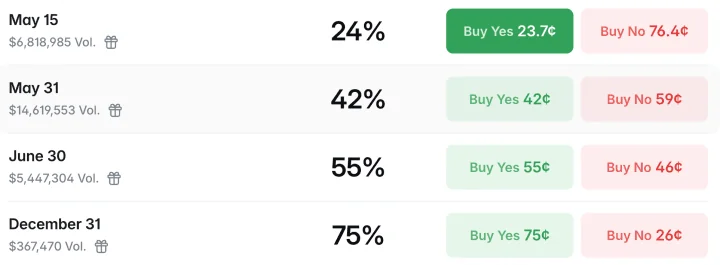
The idea is straightforward: find contracts that appear undervalued, buy at a lower price, and sell if the market later raises its implied probability. Whether you profit depends on timing, liquidity and the price you eventually get.
Consider an NFL example: will the Patriots qualify for this year’s Super Bowl?
| Point in the Season | What Happens | 'Yes' Contract Price | Your Action |
|---|---|---|---|
| Week 5 | The team loses 3 straight games | $0.15 | Buy 100 shares ($15) |
| Week 12 | The team wins 5 games in a row | $0.45 | Keep your position |
| Week 16 | They clinch a playoff spot | $0.70 | Sell 100 shares ($70) |
Your $15 became $70, a profit of $55, without waiting for the Super Bowl in February. This is one possible result, not a guaranteed outcome.
How the timing of entry and exit affects returns
Picking the right outcome is only one part of the decision. When you enter and leave a position can also have a significant effect on your eventual return.
Buying after favourable news has already raised the price leaves less room for a gain. Selling too soon out of anxiety could mean missing a later rise, but holding on longer carries risks too.
Common Pitfalls in Reading Prediction Market Prices
It is easy to misread a market if you focus only on its headline price. Here are some common traps to watch for.
Why price is not the same as certainty
A high price does not guarantee an outcome. A contract priced at $0.95 represents a 95% market-implied probability, but the remaining 5% chance is real and may occur more often than intuition suggests. Treating the price as certain can be costly: an upset can send a $0.95 contract to $0.00 immediately.
How overlooking liquidity can lead to misreading market signals
A price spike in a low-volume market can be misleading. When little money is changing hands, one buy order can make momentum look stronger than it is. Check the trading activity behind the move: hundreds or thousands of dollars in recent trades give it more context, while a movement without that support may be little more than noise.
How reacting too strongly to short-term movements can lead to poor decisions
Impulsive reactions are among the most harmful trading habits. Some price swings are temporary overcorrections, and reacting to them can mean buying high and selling low. A more disciplined approach is to follow the data, distinguish useful information from noise and make decisions with a clear head.
Why Prediction Market Pricing Matters
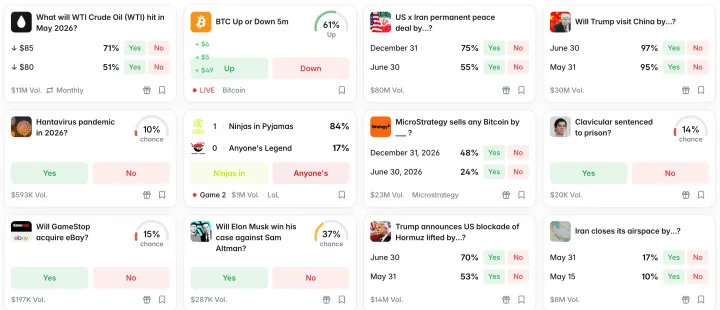
Understanding how prices work matters to anyone using or studying prediction markets. Prices combine the views of many participants and can provide a useful signal when forming an independent forecast, but they are not certain.
How market prices gather information from many participants
One market price condenses the research, analysis and opinions of many traders into a single percentage. It reflects what they know, how strongly they hold their views and how much financial risk they are prepared to take. It is not just one person’s opinion, but the market’s combined position.
Why understanding prices helps traders and observers make decisions
When you can interpret contract prices accurately, you can go beyond gut instinct and make decisions informed by market data. This can help people trading in the hope of making a profit, as well as observers following public sentiment or potential developments. Reading prices carefully offers a direct indication of what the crowd currently expects.