

How to Play Blackjack: Rules and Tips
Blackjack may seem complicated at first, but its basic format is easy to learn. This Casino Ideal guide covers the core rules, card values, odds, payouts, table actions and more. Want to understand the game before betting against the dealer? Read on.
Basic Blackjack Rules: How to Play
To win at Blackjack, build a hand as close to 21 as possible without going over. The dealer is also aiming for 21, so a hand closer to that total generally has a better chance of winning. Go over 21 and you bust, losing the hand. If your total matches the dealer’s, it’s a draw known as a push.
Blackjack is played with several decks, most often six, though games can use anywhere from one to eight. Once you place your opening wager in the table’s betting box, the dealer gives two cards to each player and themself. All cards are dealt face up. Players total their cards and decide whether to take more, aiming to get as close to 21 as possible. You can keep drawing until you stand, reach 21 or exceed 21 and bust.
In a land-based casino, as many as six other players may sit at your table, with the dealer across from you. Players compete against the dealer, not each other. Play moves from left to right, then it is the dealer’s turn. A winning hand generally pays 1:1, returning your stake and awarding an equal amount in winnings. For example, a winning $50 bet gives back the stake plus $50 in winnings.
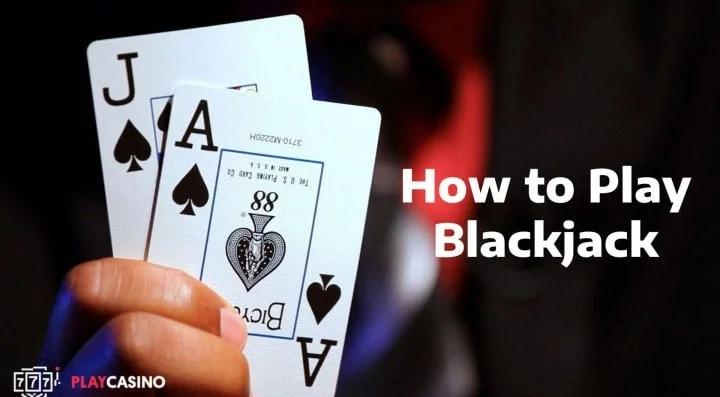
The key exception is a “blackjack”: a two-card 21 formed by an Ace and a ten-value or face card. The usual payout is 3:2; check the table’s posted terms before playing.
A typical table might have a $5 minimum bet and a $500 maximum. Limits vary by casino and table, but these are common examples.
Blackjack Odds and House Edge
The odds of winning at blackjack are close to 50%, and figures of 46-48% are often cited. They are not exactly 50/50 because the player acts first and can bust by going over the limit before the dealer plays.
Using basic blackjack strategy, the house edge is stated as 0.5%. In practice, this means choosing the mathematically correct move for your hand and the dealer’s hand, as explained in more detail below.
Put another way, a 0.5% house edge means many blackjack tables have a 98.5% RTP. This RTP (return-to-player) is described as the highest among casino games. For comparison, the lowest listed house edges for other games are:
- Baccarat: 1.06%.
- Video Poker: From 0.76% to upwards of 5%, depending on the game.
- Roulette: 2.70% for European and French variations, or 5.26% for American Roulette.
- Video Slots: From 1% to around 12%, depending on the game.
Note: Blackjack’s relatively low house edge helps explain its popularity at many casinos. It can offer better prospects over the long term, but it does not guarantee a win.
Blackjack Card Values
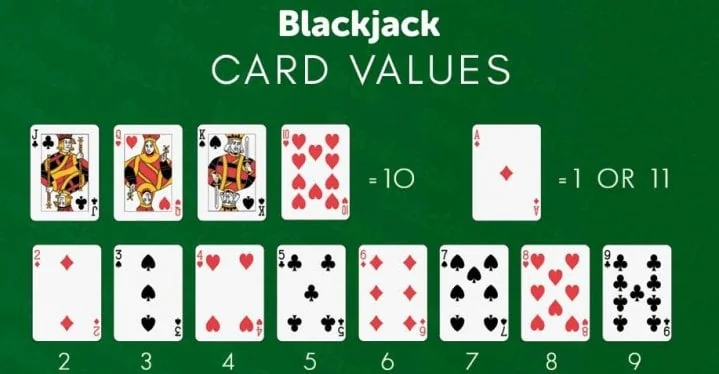
To build a total toward 21, start by learning each card’s value. Number cards count as shown: a three is worth 3, and a six is worth 6. Jacks, Queens and Kings are face cards, each worth 10. An Ace can count as either 1 or 11, depending on your choice and what the hand can support without going over 21.
For example, an Ace and a 7 can make 8 or 18, so use whichever value suits the hand. If you draw a 4 next, the Ace automatically counts as 1, making the total 7 1 4 = 12. An opening Ace is useful because you can count it as 1 if a high card follows. The strategic implications are covered below.
Essential Blackjack Terms
A number of terms come up during a blackjack round. Here are the ones you are most likely to hear:
- Hit – Ask the dealer for another card.
- Stick / Stand – Keep your current hand instead of taking another card.
- Bust – Draw a card that takes your total over 21.
- Push – Tie the dealer’s score and get your original wager back.
- Split – If your first two cards are a pair, such as 2 6s or 2 Jacks, separate them to form two hands. Each hand receives another card and requires the applicable extra wager.
- Double Down – Double your original wager to receive one more card.
- Surrender – Give up your hand before playing it and get back 50% of your original wager.
- Soft hand – A hand with an Ace counted as 11.
- Blackjack – A 21 made with just two cards: an Ace and a face card or a 10. Blackjack usually pays 3:2.
For more definitions, read our Blackjack Glossary and Terminology article.
Basic Blackjack Actions
Standard blackjack tables usually offer the following options. Which ones are available depends on your hand and the situation:
- Hit: Choosing “hit” asks the dealer for another card. You can keep hitting as long as your total is 21 or less.
- Stand: When you “stand,” your turn ends with your current hand and you take no more cards. Players generally stand when their total looks strong enough to challenge the dealer, or when another card could put them over 21.
- Double Down: “Double down” means doubling your opening wager and taking one more card. Players generally consider it when the hand looks promising and a larger wager could increase the potential return.
- Split: “Split” divides a pair into two hands, each requiring an additional wager. It may be allowed for cards of the same rank or for a pair that could make strong hands. The eligible pairs and number of permitted splits depend on the blackjack variation.
- Surrender: When you “surrender,” you give up the hand and receive half of your original wager back. Depending on the blackjack variation, surrender may be early or late. Players generally consider it when the chance of winning is low and limiting the loss is preferable.
How a Blackjack Hand Unfolds
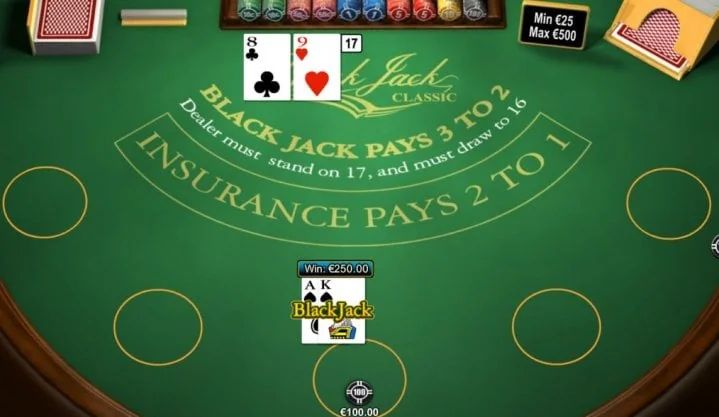
After players place their opening wagers in the betting box or circle, the dealer gives each player two face-down cards. The dealer also receives two cards, one face up. To win, a player must finish with a higher total than the dealer without going over 21. After seeing their cards, players can hit, stand or surrender. Turns pass around the table from left to right, and the dealer plays after everyone else. The aim is to beat the dealer, not the other players.
Early surrender means giving up before drawing any additional cards. If the option is available and you use it, half of your original wager is returned.
You can draw more cards until you reach 21, exceed that total and lose, or stand. After players have acted, the dealer reveals the hidden card and follows the table’s rules. With the “17” rule, the dealer must stand on 17 and draw on 16 or less. This set procedure gives the dealer fewer choices than the player.
Once the dealer has finished, hands are compared and winning players are paid. Equal totals are a tie, known as a push, and the original wager is returned.
Hard and Soft Hand Rules
Before you sit at an online or land-based blackjack table, check whether the dealer follows hard or soft rules. “S17” and “H17” refer to what the dealer does with a soft 17—a hand that includes an Ace counted as 11. These rules can affect the house edge and players’ decisions. Here’s what each one means:
S17 (Stand on Soft 17)
At a table with the S17 rule:
The dealer stands on a soft 17. For example, if the dealer has an Ace and cards worth 6, such as Ace-6 or Ace-2-4, they do not draw again and stand on 17.
This rule is more favourable to players because a dealer with a weak starting hand has a greater chance of busting by going over 21. It also lets players make more cautious decisions after considering the dealer’s upcard.
H17 (Hit on Soft 17)
At a table with the H17 rule:
The dealer must hit on a soft 17. So, if the dealer has an Ace and cards worth 6, they take another card.
This rule is less favourable to players because it gives the dealer another chance to improve their hand and lowers the chance that a weak starting hand will bust.
Note: S17 tables are generally seen as more player-friendly because the dealer stands on a soft total, which can increase the chance of a bust. H17 gives the dealer another opportunity to improve their hand. Check which rule applies before playing blackjack online or at a casino, as it can affect strategy and winning odds. Many players prefer S17 for its slightly better odds, but your decisions should still reflect the rule in play.
Deck Count
The number of decks is another table detail to check, along with the hard and soft rules. Deck count can affect the house edge and may influence strategy. In general, fewer decks are more favourable to the player.
- Single Deck Game: One-deck tables have the lowest house edge and are easier for anyone considering card counting. To offset these advantages, single-deck games often have stricter conditions, such as limits on when you can double down or split.
- Double Deck Game: Double-deck games occasionally appear at online casinos. Their odds can be more favourable than those of multi-deck tables, and their rules may be less restrictive than single-deck games.
- Multiple Deck Game: Many blackjack tables use multiple decks, usually four to eight shuffled together. Casinos often prefer this format because it makes card counting more difficult and raises the house edge.
Players often have limited choice over the number of decks. Online casinos and land-based venues in Las Vegas and other major gambling destinations commonly offer multi-deck games with four or more decks. If you come across a single- or double-deck table,
Blackjack Insurance Bets
Insurance is an optional side bet offered when the dealer’s upcard is an Ace. It pays 2-1 if the dealer has blackjack, made up of an Ace and a 10-point card. The insurance wager is usually capped at half the player’s original bet.
For example, if your original wager is $10, the insurance wager would be $5. If the dealer has blackjack, your original $10 wager loses, but the insurance bet wins $10, for a net loss of $5. If the dealer does not have blackjack, the insurance bet loses, while you can continue playing your original hand.
Insurance is designed to protect your original wager if the dealer has blackjack. However, the odds generally favour the house, so players are usually advised against taking it. It is a negative-expectation wager: over time, you are expected to lose more often than you win.
Splitting Blackjack Hands
You can split when your opening hand meets the table’s conditions. Splitting turns your original cards into two separate hands, each requiring its own wager and increasing your total stake. Rules vary across blackjack versions, so check them before playing.
- Splitting Tens: Jacks, Queens, Kings and 10s are all worth ten points. Many online casinos allow these cards to be split, but some require matching ranks, such as two Kings or two 10s, rather than a King and a 10.
- Resplitting: A pair may be split again, often up to three times for a hand. Depending on the game, the limit may instead be one split, six splits or none. For example, a player could split a pair of 8s, then split again if an eight is dealt to one of the new hands.
- Resplitting Aces: This uncommon rule is generally associated with Late Surrender games.
- Additional Draw after Splitting Aces: Usually, splitting Aces lets you draw only one card for each Ace. Some versions lift this restriction and allow further draws.
- No Split Aces: This rare rule does not allow players to split Aces. If it applies, you may prefer to avoid that blackjack variation.
- Split Anytime: This rule allows a player to split after hitting. For example, if you are dealt 10 and 2, then draw another 2, you can split the deuces into separate hands.
- Split any 16: This rule lets you split any combination that totals 16, regardless of the cards involved, including 10 and 6, Ace and 5, or 9 and 7.
- No Splits on 4, 5 or Ten: This rule is used in UK casinos.
- Discard Split Hand: This uncommon but useful rule lets a player discard one hand after splitting.
Doubling Down
Doubling down lets you double your opening wager in return for one more card. The option is available only after your first two cards and before you draw again. It can raise the potential payout on a strong hand or improve a hand that may beat the dealer.
The upside is a chance to win more on a hand that looks strong. It can also increase the return from a hand that seems likely to win.
The downside is that doubling raises the risk of busting—going over 21 and losing the full wager. It can be costly if the hand is weaker than it first appeared.
Consider the dealer’s upcard before doubling down. Doubling with a total of 10 or 11 is generally considered useful when the dealer shows a low card, such as 2-6.
Blackjack Tips and Advice
Blackjack still involves a substantial element of chance. You cannot control the cards dealt to you or the dealer, and card counting is not possible in software games. However, you can make informed decisions and manage your play. Here are 10 ideas to consider.
- Practise for free: Try an online casino’s practice mode to get familiar with the game before risking your own money.
- Use a strategy chart: Keep a basic blackjack strategy chart handy so you can check the recommended move for each situation.
- Set a budget: Decide on a budget for your blackjack session in advance and stick to it.
- Pick an appropriate table: Look for tables where the minimum bet is no more than 5% of your budget.
- Follow basic strategy: Hit totals below 17 when the dealer shows 8, 9, 10 or a face card, and stand on totals above 11 when the dealer shows 4, 5 or 6.
- Skip insurance bets: Insurance against the dealer making blackjack is often called a “sucker’s bet” and is generally best avoided.
- Use doubling down strategically: Double your wager on a ten-value card when the dealer’s upcard is nine or lower, or whenever your hand totals eleven.
- Know when to split: If your first two cards have equal value, split by matching your original wager. Avoid splitting 10s or 5s, but split 7s or 8s when the dealer has a lower-value hand.
- Try progressive betting: Some players increase their wagers during a winning streak and reduce them during a losing streak. This does not alter the underlying odds.
- Consider live dealer games: Live dealer games let you watch the table more closely and may allow card counting, unlike software games. Casino rules and policies still apply.
Blackjack Basic Strategy
To make sound decisions during a blackjack session, use basic strategy. Its guidelines compare your cards with the dealer’s upcard to identify the mathematically preferred move. Players often refer to a strategy chart for each situation. Following one can reduce the casino’s advantage, but it cannot eliminate the house edge or guarantee a win.
Your hand and the dealer’s exposed card determine whether to hit, stand, double down, split or surrender.
Basic strategy covers many situations. Our Blackjack Strategy Charts article explains in more detail how to play efficiently. Its key principles include:
- Always hit on a hand worth 12 or less.
- Always stand on a total of 17 or more.
- For totals from 13 to 16, consider the dealer’s upcard.
- In that range, stand when the dealer shows 2 through 6.
- Conversely, hit when the dealer’s upcard is 7 through Ace.
There are additional decisions about doubling down, which doubles your wager, and splitting pairs, which separates two cards of equal value and type into separate hands. Review the full basic strategy to see when each move is recommended.
Blackjack: Pros and Cons
Like any casino game, blackjack has benefits and drawbacks. In our view, it can compare favourably with other table games. Skill does not determine every outcome, but informed decisions may help limit avoidable losses.
Benefits of Playing Blackjack
Blackjack offers a number of potential advantages:
- Low House Edge: With suitable strategy, blackjack is known for having one of the lower house edges among casino games. Skilled players may bring the edge below 1%, making it comparatively favourable, though never risk-free.
- Skill-Based Game: Unlike games driven mainly by luck, blackjack gives players meaningful decisions. Learning and applying basic strategy can improve the mathematical odds.
- Many Variations: Traditional and online casinos offer a wide range of blackjack versions. You can compare their rules, formats and odds to find one that suits your preferences.
- Social Element: At land-based casinos, blackjack is often played with others at the table, creating an interactive atmosphere. Many online versions also have chatrooms that add to the table experience.
- Potential for Profit: Skilled players using strategy and card counting may profit in favourable conditions, but a profit is never guaranteed. Blackjack’s relatively low house advantage may attract professional gamblers; it is not evidence of dependable income.
Drawbacks of Playing Blackjack
Even experienced blackjack players should bear these potential drawbacks in mind:
- House Rules: Casino rules vary, and small differences can affect the house edge and the right strategy. You need to adapt your decisions to the table’s specific conditions.
- Card Counting Is Difficult: Card counting may work in some circumstances, but learning and using it is difficult. Casinos also take measures to identify and discourage the practice.
- Emotional Pressure: Losing streaks and poor decisions can make blackjack emotionally challenging. Discipline and control over your reactions are important.
- House Advantage: Even when the house edge is low, the casino has a long-term advantage. Over time, players are expected to lose more than they win.
Getting Started with Blackjack

Many online casinos offer blackjack for new players, experienced users and high rollers. Beginners can seek out low stakes and a generous welcome bonus, while free blackjack games let you practise before wagering real money. This can be a practical way to get acquainted with the game.
Splitting, doubling down, surrendering and the value of an Ace add rules to learn, but the basic format is easy to follow. That makes blackjack approachable for people new to online gambling. Learn the rules, practise responsibly and decide if the game is right for you.
Online Blackjack Table Game Variations

Online blackjack offers a wider choice of variations than a land-based casino. Tables commonly feature standard formats at different betting limits, including games with both S17 and H17 rules.
Online casino software and live game providers can offer formats that may not be found in land-based casinos. These versions add features while keeping blackjack’s core structure. Once you know the standard game, the differences in many variations are easier to understand.
Here are some blackjack games you may find at online casinos:
- All Bets Blackjack (Playtech Live): This game is designed for players interested in side bets. It uses eight decks and offers seven side bets that can be placed separately from the main hand. Each side bet has its own RTP, and its house advantage is higher than that of the main game.
- Infinite Blackjack (Evolution): This live casino game uses unlimited-seat technology, so players do not have to wait for a seat as they might at 7-seat blackjack tables. Everyone plays the same hand dealt by the dealer. The trade-off is that cards dealt to other players do not provide useful information. Infinite Blackjack also has four side bets.
- Blackjack Switch: This version lets players exchange cards between two hands. Each player plays two hands in a round and can “switch” the top cards. The extra feature comes with different rules: a dealer total of 22 pushes all hands that have not busted, and a “Blackjack” pays 1:1 instead of 3:2.
- Free Bet Blackjack (Evolution): This live game offers free bets for certain doubles and splits. Doubling is available when the first two cards total 9, 10 or 11, and a further free split may be offered if a previous split produces another pair. A dealer total of 22 results in a push, offsetting those free bets.
- Random Multiplier Blackjack Games (Multiple): Several live casino providers offer games with random multipliers, including Lightning Blackjack (Evolution) and Quantum Blackjack (Playtech Live). Lightning Blackjack has a side bet that pays 2x to 25x the wager after two consecutive winning hands. Quantum Blackjack uses three random cards with a 10x multiplier value that can stack for a larger bonus payout.
- These are just a few of the blackjack variations available online.
Play Blackjack Online Today
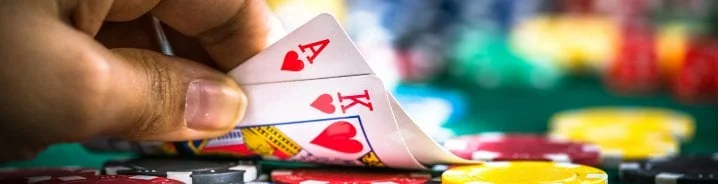
Once you know how blackjack works, you might want to try this casino table game for yourself. The appeal lies in placing chips and hoping to beat the dealer without busting.
Casino Ideal can help you explore online casinos offering online blackjack. Many casinos have both RNG (random number generator) and live versions. Compare platforms by reading our top-rated casino reviews and checking the relevant terms before you play.