

Roulette Odds: A Comprehensive Guide
Roulette is one of the casino's oldest games, but chance determines how likely a bet is to win, while the payout determines its return. Before playing, it helps to understand the odds for each roulette bet. Knowing how different bets work can help you compare options and set realistic expectations, but no choice guarantees consistent profits.
What Are Roulette Odds?
Roulette odds describe the chance that a particular bet will win. At an American roulette table, the straight-up bet has the longest odds. Selecting a single number gives you a 1 in 37 chance of success, since the wheel has 38 numbers: 1-36, 0, and 00. Even if your number lands, the house edge means the payout is only 35:1. The house edge is the share of wagers the casino retains over time, giving the house (casino) a mathematical advantage. American roulette is generally considered the least favourable roulette variant, as we explain later.
Straight-up bets are just one option. Roulette offers several bet types with different payouts, while outside bets such as odd or even give you better chances of winning in exchange for smaller returns.
How to Calculate Roulette Table Payouts
Before your first roulette game, make sure you understand the odds and payouts for each available bet. It is also common to be unfamiliar with the bet names or where to place chips on the layout. Learning the different options beforehand makes the betting table easier to read and helps prevent confusion.
At land-based and online roulette tables, payouts are commonly written as (number):1. The number shows how many units you win for each unit staked. For instance, a four-number bet pays 8:1: your original 1-unit stake is returned along with 8 winning units.
American and European Roulette Payout Guide
The payout chart below offers a practical comparison of the odds for each bet in American and European roulette. French roulette has the same odds as European roulette, so the two versions appear together in the same section.
Roulette Bet Description and Example Payout French and European Roulette Odds (%) American Roulette Odds (%) Straight-Up Bet Bet on a single number 35:1 2.70% 2.63% Split Bet Bet on 2 adjacent numbers 17:1 5.41% 5.26% Street Bet Bet on 3 numbers in a row 11:1 8.11% 7.89% Square Bet Bet on 4 numbers forming a square 8:1 10.81% 10.53% Line Bet Bet on 6 numbers across 2 adjacent rows 5:1 16.22% 15.79% Column Bet Bet on 12 numbers in a column 2:1 32.43% 31.58% Dozen Bet Bet on the 1st, 2nd, or 3rd group of 12 numbers 2:1 32.43% 31.58% Even/Odd Bet Bet on all even or all odd numbers 1:1 48.65% 47.37% Red/Black Bet Bet on all red or all black numbers 1:1 48.65% 47.37% 1-18/19-36 Bet Bet on the first or last 18 numbers 1:1 48.65% 47.37%
Note: These odds are calculated by dividing the winning outcomes by the total possible outcomes. Since American roulette includes 00, its chance of winning is lower than in French and European roulette.
Roulette Payouts and the Betting Table
The roulette layout can look confusing when you start playing roulette. It features many numbers and betting areas, some of which may be new to you. Understanding its main sections makes it easier to see where each bet belongs.
The easiest way to read the betting table, or its online equivalent, is to divide it into two areas. The central grid contains the inside bets, including single-number bets. Around the right and bottom edges are the outside bets, including red or black and odd or even.
Outside Roulette Bets: Lower Risk, Lower Payouts, and Better Chances of Winning
Outside bets sit beyond the numbered grid, hence their name. They offer the most favourable roulette odds and the lowest payouts. They win more often than inside bets, but the returns are smaller. Even-money bets such as odd or even pay 1:1 when they win because they cover about half the table and come close to 50/50. The zero pockets, however, prevent a true even split.
Column and dozen bets offer the largest outside-bet payout, at 2:1. Each covers roughly 1/3rd of the wheel, so it wins less frequently than an even-money bet but pays more when successful.
Bet Type Bet Description Payout Column Bet Bet on 12 numbers in a column 2:1 Dozen Bet Bet on the 1st, 2nd, or 3rd group of 12 numbers 2:1 Even/Odd Bet Bet on all even or all odd numbers 1:1 Red/Black Bet Bet on all red or all black numbers 1:1 1-18/19-36 Bet Bet on the first or last 18 numbers 1:1
Note: The 'Payout' column lists winnings in addition to the original stake. For a winning 'Column Bet', a $1 wager earns $2 in winnings, and the original $1 is also returned, for $3 total.
Inside Bets: Higher Risk and Bigger Payouts
Players willing to take on greater risk in online roulette can choose from its many inside bets. On the main betting grid, you can cover a single number, a group, or any combination the table allows.
If the ball lands on a number you covered, the payout can be substantial. These bets have longer odds, however, so losing outcomes occur more often than winning ones.
Bet Type Bet Description Payout Straight-Up Bet Bet on a single number 35:1 Split Bet Bet on 2 adjacent numbers 17:1 Street Bet Bet on 3 numbers in a row 11:1 Trio Bet Bet on 3 numbers, including at least one zero (0 or 00) 11:1 Corner Bet Bet on 4 numbers forming a square 8:1 Five-Number Bet (Basket) Bet on 0, 00, 1, 2, and 3 (American roulette only) 6:1 Line Bet Bet on 6 numbers across 2 adjacent rows 5:1
Note: The Five-Number Bet (Basket) is available only in American roulette and covers both 0 and 00.
Bets on American and European Roulette Wheels
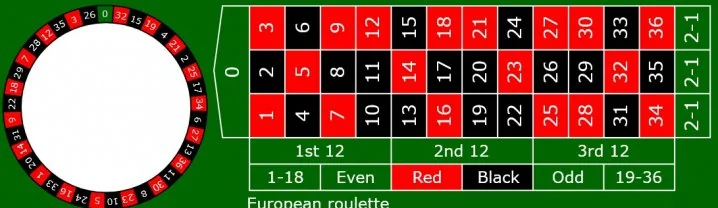
As noted earlier in this roulette odds guide, American roulette gives the house a greater advantage than French and European roulette. American roulette has a 5.26% house edge, almost twice the 2.7% edge found in the other variants.
The house edge represents the casino's mathematical advantage over roulette players and indicates the share of wagers a table is expected to retain over time. The same concept can be expressed as RTP, or return to player percentage. French and European roulette has a 97.3% RTP, meaning players receive that proportion on average over an extended period.
Over the long run, players receive an average of 97.3% of their bets back. This does not predict what will happen in an individual session: chance can produce very different results. One player might double their bankroll, while another could lose it all.
Why Does American Roulette Have a Higher House Edge?
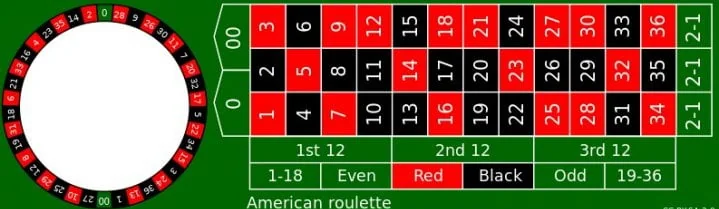
The difference comes from an extra green pocket on the American wheel. When roulette came to America, casinos increased the house advantage by adding another green pocket to the traditional layout.
European and French roulette use a single-zero wheel with one green pocket. That pocket creates the game's house edge. Although a bet on zero pays like a bet on any other number, zero defeats many other wagers because it is neither odd nor even, red nor black, and is not considered high or low. Most table bets do not cover it, giving the casino an advantage when the green zero appears.
American roulette keeps the European payouts but offers worse odds for players because its double-zero wheel adds another green pocket, 00. This extra pocket increases the house edge: when it lands, it also defeats most bets on the table.
Avoid American roulette: Given its higher house edge, we recommend choosing a single-zero roulette variant such as European or French. If the game you have opened uses a double-zero wheel, switch to another table. American roulette offers no advantage over the other two variants.
French and European Roulette: Neighbour Bets (Racetrack Bets)
European and French roulette often feature a distinctive element called the 'racetrack'. This separate betting area is generally positioned around the outside of the table.
The racetrack maps neighbouring numbers that sit next to each other on the wheel. These groupings are known as 'section bets' or 'neighbour bets' and combine elements of straight, split, and corner bets.
French roulette commonly names these bets in French, while European roulette usually translates the groups of adjacent numbers into English. All neighbour bets have the same 2.7% house edge, but their chances of winning vary.
- Tiers du Cylindre (Third of the Wheel): This wager has a 45.9% potential chance of winning and consists of six equal-value split bets. The pairs are 5/8, 10/11, 13/16, 23/24, 27/30, and 33/36. These numbers are close together on the wheel, covering the segment 27-13-36-11-30-8-23-10-5-24-16-33, which contains 12 numbers.
- Orphelins (Orphans): This wager offers a 24.3% chance of winning and requires one straight-up bet plus five equal-value split bets. The layout uses a straight-up bet on 1 and split bets on 6/9, 14/17, 17/20, and 31/34. It covers two separate groups of neighbouring numbers. 'Orphans' refers to their omission from the other listed section bets: 1-20-14-31-9 in one segment and 17-34-6 in another, covering eight numbers.
- Voisins du Zéro (Neighbors of Zero): This wager combines five split bets and two corner bets, with chips of equal value. Place two chips on 0, 2, and 3, and two chips on the corner spanning 25 to 29. Then put one chip on each of 4/7, 12/15, 18/21, 19/22, and 32/35. The wheel segment runs 22-18-29-7-28-12-35-3-26-0-32-15-19-4-21-2-25 and contains 17 numbers. This bet has a 32.4% chance of winning.
- Jeu Zéro (Zero Game): This wager targets numbers neighbouring 0. Place one chip on a straight-up bet on 26 and one on each of three split bets: 0-3, 12-15, and 32-35. In German roulette, a variation called 'zero spiel naca' adds one chip for a straight-up bet on 19, making it a 5-chip wager.
Understanding Roulette Multiplier Odds
Online players may come across multiplier roulette games. These retain familiar bets from traditional tables, including even-money bets, call bets, and the five-number bet. Their defining feature is that multipliers are assigned randomly to selected straight-up numbers. Depending on the game, multipliers can reach 500x the stake or more.
To add multipliers, developers adjust standard payouts to account for the potential larger wins. The usual trade-off is a lower payout for straight-up bets without a multiplier. In Evolution's Lightning Roulette, for instance, that payout is reduced to 29:1.
Roulette Betting Limits: Minimum and Maximum Bets
As well as choosing which roulette bets to place, consider the table's minimum and maximum limits at a land-based or online casino. Each table sets its own limits, so choose one that fits your bankroll. A minimum that is too high may use up your bankroll quickly, while one that is too low may not suit you if you prefer larger stakes.
Ideally, the minimum should let you spread your bankroll across many bets and rounds. The guidance here suggests keeping each round to no more than 5% of your bankroll, though budgeting is a personal choice and does not change the odds.
Put Your Roulette Odds Knowledge to Use at the Tables
Now that the main roulette bets, odds, and payouts are clearer, you can explore roulette games at online casinos. You can combine inside and outside bets, but every result still depends on where the winning number lands.
If you're looking for online roulette, Casino Ideal is a useful starting point. Casino Ideal's editorial reviews cover hundreds of the best online casinos. Reading them can help you compare platforms with virtual and live roulette alongside other online games, but a review is not proof of local authorization or availability.